Hyperdense: a Cyberpunk Megacity Wargame
You are the strategic operations director of the tech division of Free Cities, a faction with no central government. You do not micromanage the city, you steer tech, launch operations, and allocate resources while the city seethes largely beyond your control. Everything is abstracted to numbers on a hex map.
Beta v0.2 - Expect Frequent Updates!
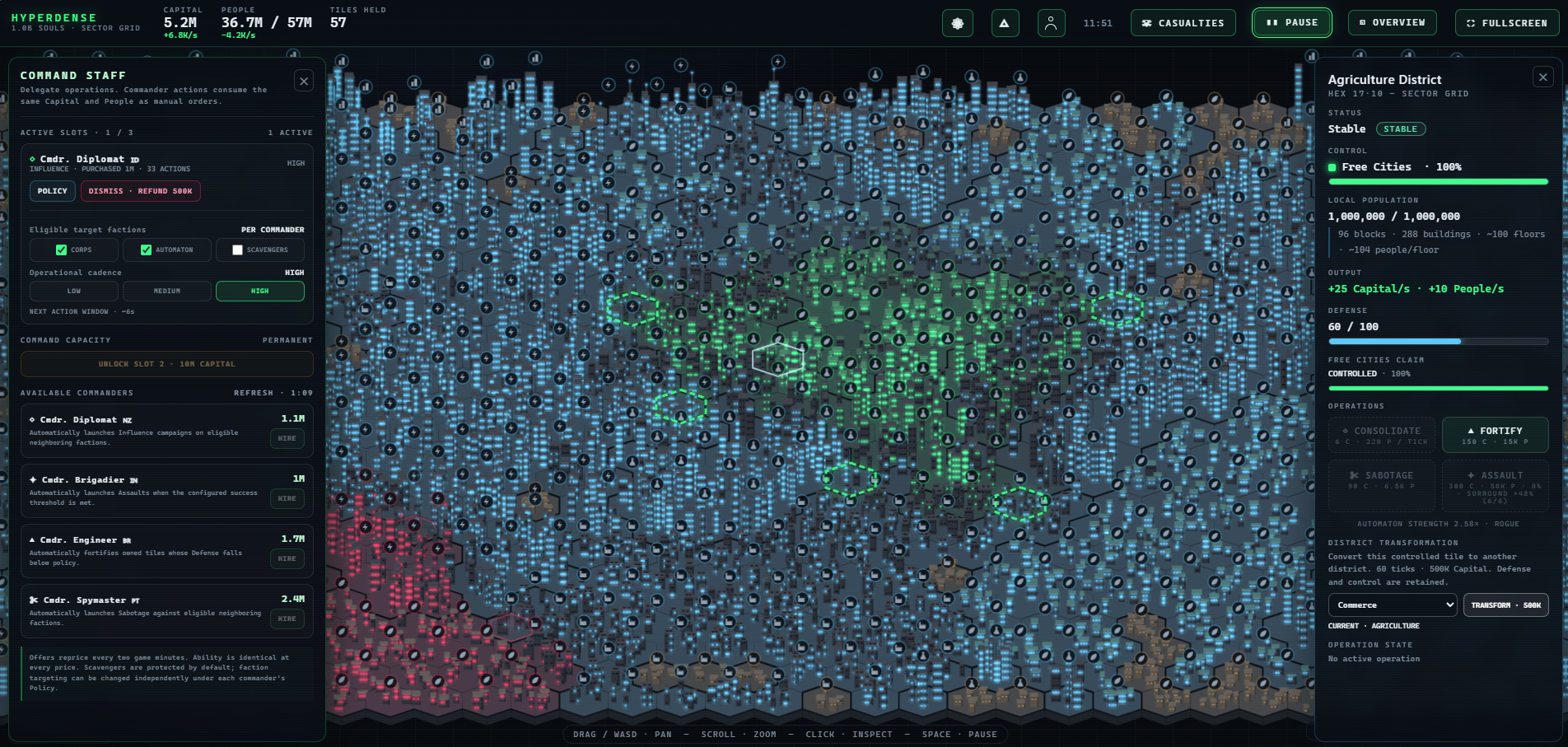
Watch resources accrue → invest in sector tech → run operations (Influence / Sabotage / Fortify / Assault) against neighboring tiles → win hearts, then seize ground → absorb attrition and rebuild → repeat outward across 1,000 tiles. Real-time with a pause button.
Win: control all 1,000 tiles. Lose: hold zero tiles.
The tension is that every war kills people, and people are both your economy and your army. Expansion is self-injuring; the winning strategy is to influence first (peaceful, hearts and-minds) and assault only when the odds and the payoff justify the blood
The whole city reduces to People and Capital. No food, electricity, or industrials as separate resources. Each tile houses up to 1,000,000 residents. This number scales that tile's output linearly, a farm tile at 500k residents produces 50% of its potential. Residents die in war and regenerate slowly on their own. People pool (faction-wide, spendable): your mobilizable manpower. It is replenished over time by the residents of tiles you own, capped at 1M × (tiles owned); so at 25 tiles your ceiling is ~25M. Missions draw from this pool. War attrition hits both: it kills residents on the contested tile (lowering its future output and slowing its regen) and drains the People pool of every faction engaged.
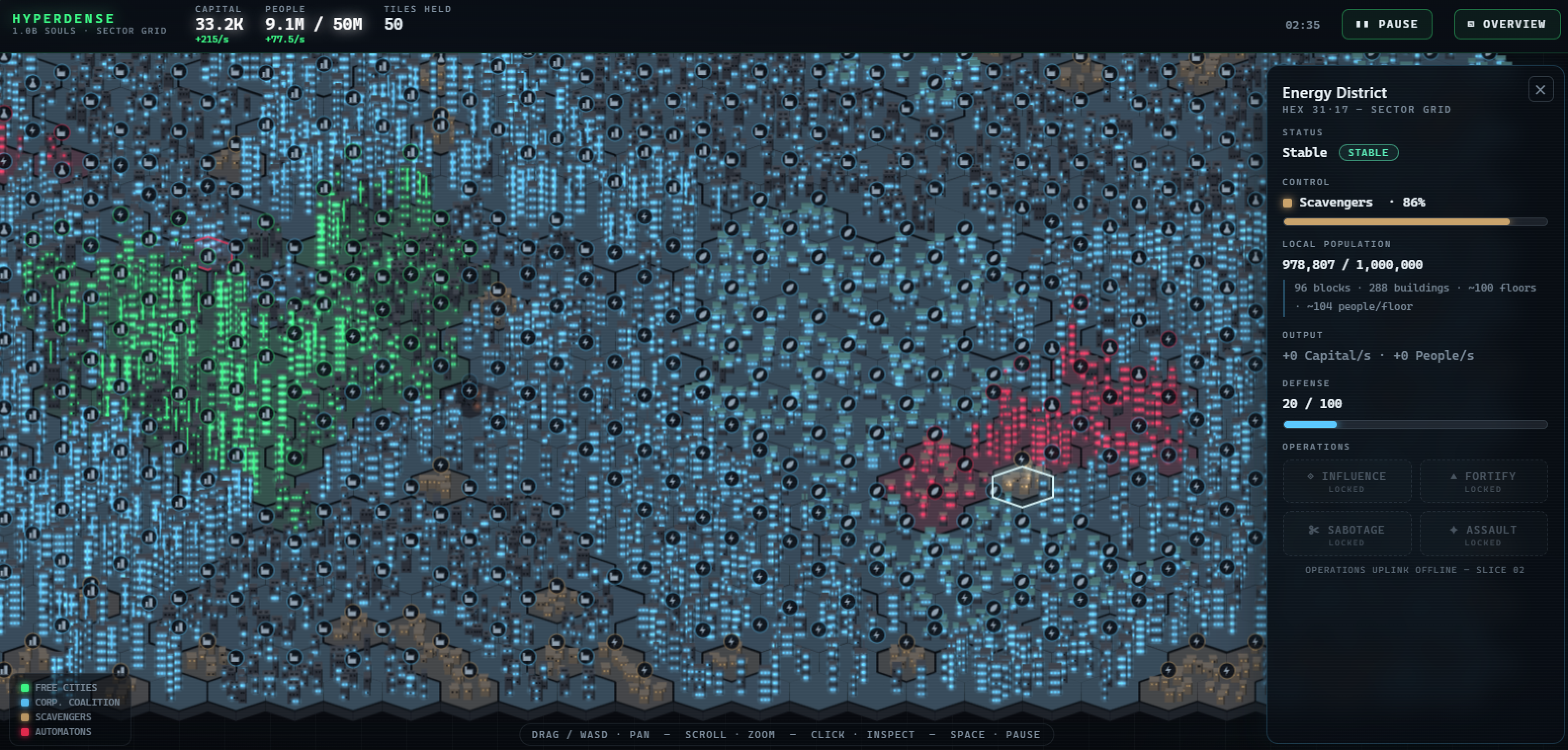
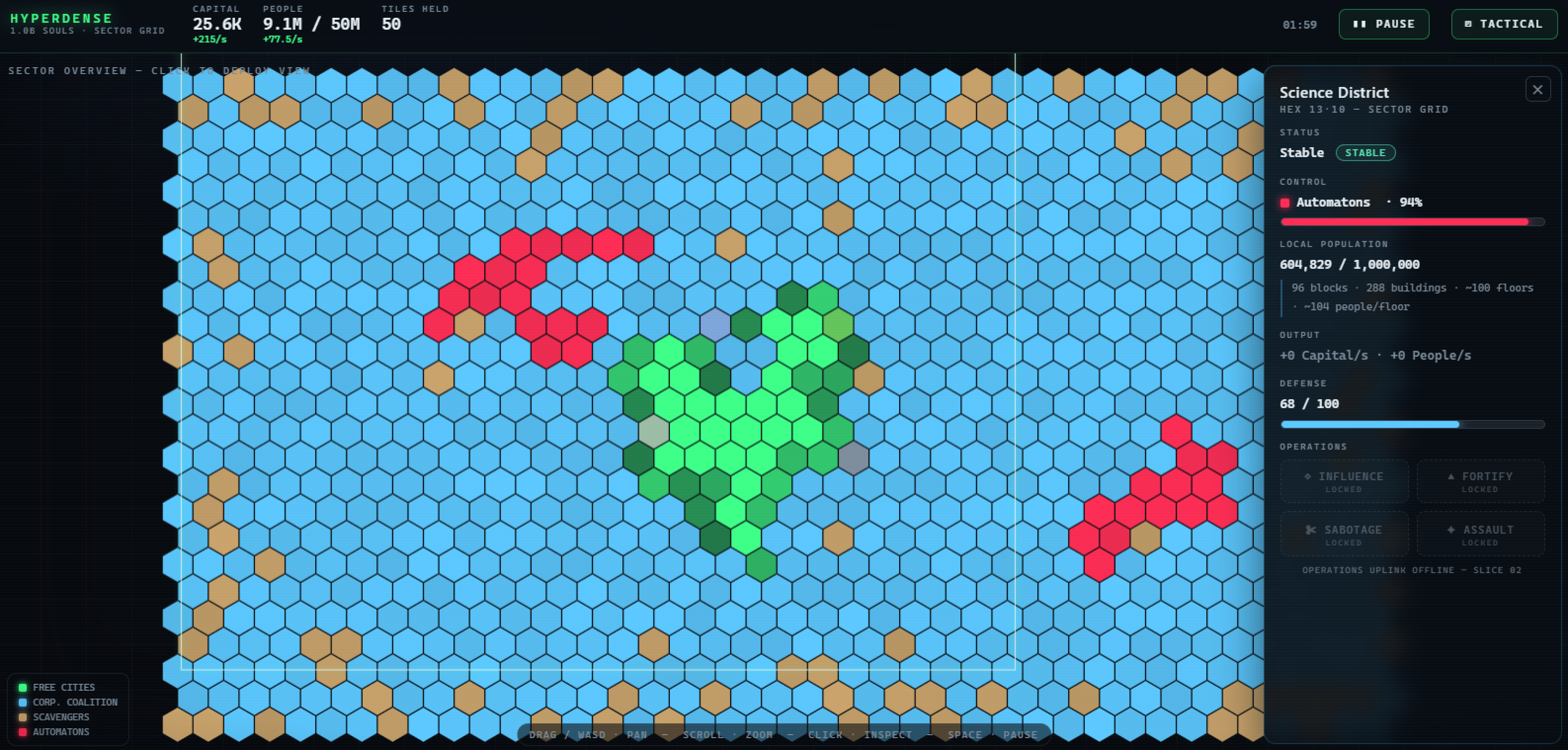
Each hex is one tile = 1,000,000 people = 96 blocks = 288 buildings (3 per block) = ~100 floors each. These density figures live in the tile detail panel as flavor/texture; they are not individually simulated.
Hearts and minds is the spine: ownership % = the share of that tile's population that backs your faction. 100% = full support and full resources; 0% = nobody's with you.
Influence — primary expansion path. Spend Capital (small People) over several ticks to raise your ownership % on a target. Rate scales with your Science tech and your faction's influence modifier, and is resisted by the current controller's grip. Peaceful, no deaths. Free Cities excel here (×~1.5); the Coalition is bad at it (×~0.5).
Assault — seize ground without full support. Roll to capture; success chance ≈ your current ownership % on that tile (modified by military strength vs. the defender's Defense). A 0% tile is a guaranteed failure; a 10% tile is a 10% gamble that still costs People and Capital — and if you win it, you own it at only 10% and collect 10% of its output until you Influence it up. Crucially, once captured by assault, that tile becomes much cheaper to Influence (you hold the ground). Resolves over ~8–15 ticks as a Contested warzone: residents die on the tile, and both factions' People pools drain each tick. Costly by design.
Fortify — spend Capital + People to raise a tile's Defense stat. Higher Defense = harder for enemies to assault it, and longer survival as a warzone before it collapses into Rubble.
Sabotage — cheaper than assault; spend Capital + People to cut an enemy tile's ownership %, knock it Unstable, or lower its Defense to soften it before an assault. Strong tool against the resource-rich Coalition
Tech — global tiers, per sector Your main lever. Five sector branches (one per district type), each ~3 tiers, bought with Capital at escalating cost. Each tier globally multiplies that sector's tile output (≈ +25%/tier, tunable).
Invest heavily into Agriculture and every farm tile you own gets far more effective; the same for the others. Science branch is dual-purpose: beyond boosting Science-tile Capital, its tiers increase Influence potency and lower tech costs, thematically. Your smarter faction also wins hearts and researches faster. This is why Science underpins the peaceful expansion strategy. Energy branch amplifies its global output multiplier
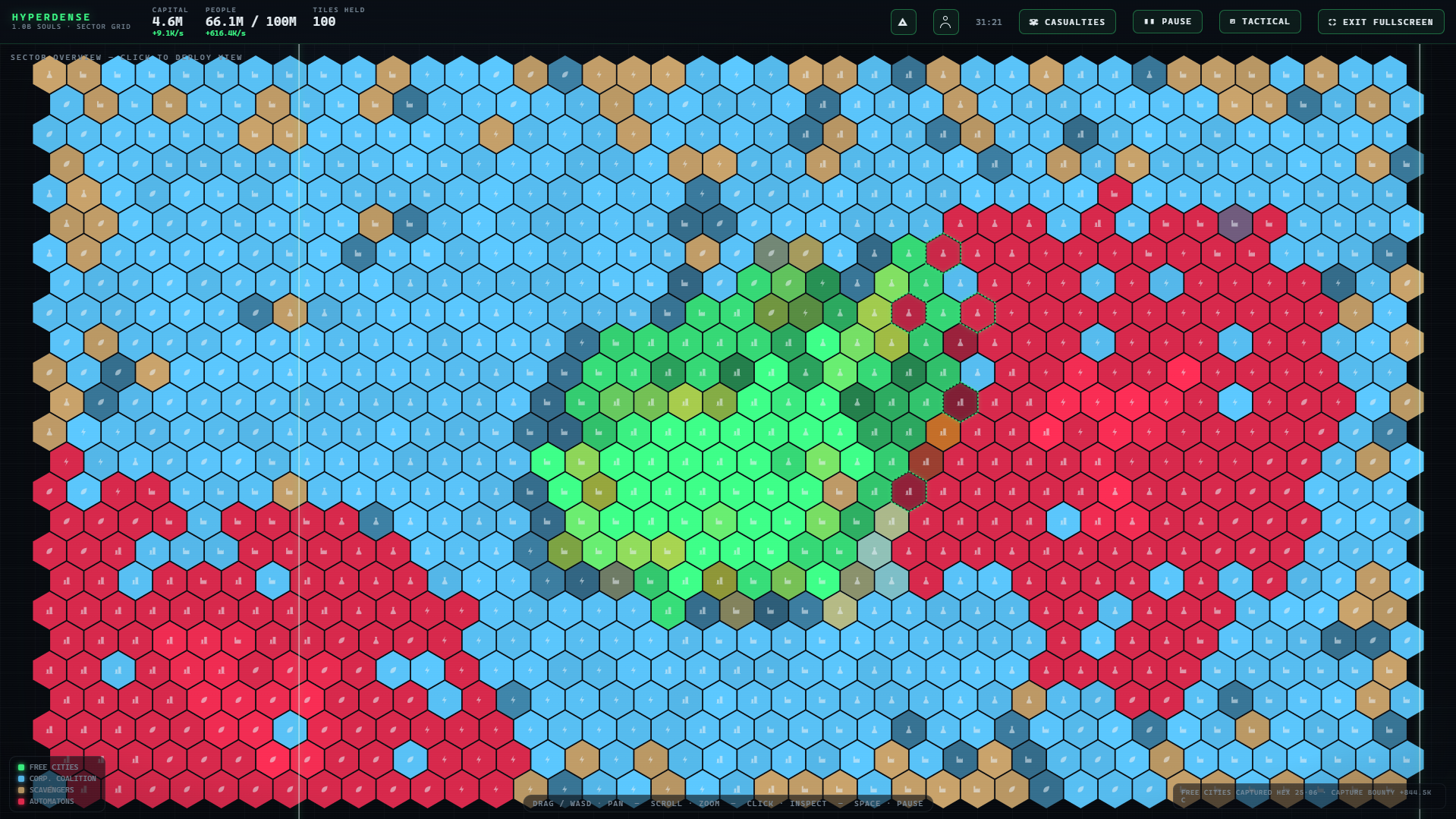
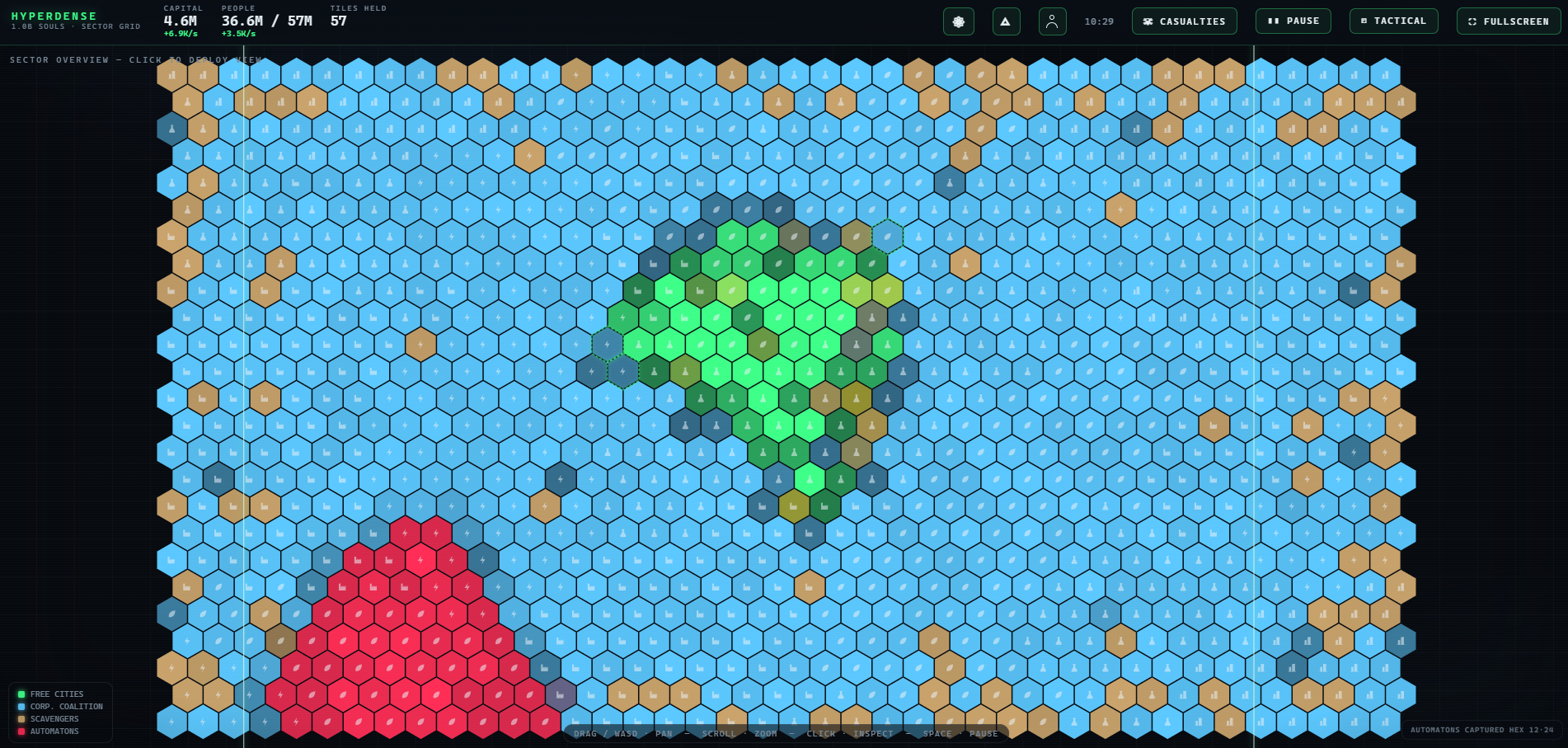
Free Cities (player) — neon green. Efficient (tiles out-produce their owner-count) and superb at influence; militarily weaker than the Coalition.
Corporate Coalition — light blue. The major enemy. Owns most of the map; deepest People and Capital reserves; strong military; weak influence and inefficient tiles (less output per tile owned). That inefficiency + poor hearts-and-minds is the balance lever you exploit. Behavior: steadily contests your border tiles and buys down your in progress tiles.
Scavengers — weak, allied and worth protecting. Occupy marginal/fringe ground and act as a buffer. Scavenger tiles periodically gift you Capital (salvage) and grant small intel bonuses to Influence/Sabotage; if they're wiped, you lose those bonuses and the aggressor gains ground.
Automatons — neon red. Tiny and weak at start, allied to the Coalition, but carry a compounding strength multiplier that grows every tick. A slow, exponential advantage that turns them into the late-game crisis, eventually ignoring their alliance and overrunning tiles fast. Give them a visible threat-level meter so the player feels the clock ticking and is punished for ignoring them early.
Download